
For us to understand why public participation is important, we need to start with a clear understanding of the Environmental Impact Assessment (EIA) process.
Any proposed development or activity that has the potential to have an adverse impact on the environment or a community needs to undergo an EIA or Basic Assessment (BA). An EIA is a comprehensive environmental assessment methodology that looks at all the potential environmental impacts associated with a proposed development or activity. It takes into consideration the environmental aspects of the proposed area in which the development or activity is scheduled to occur, as well as the social factors such as proximity to communities and how it will influence traffic and employment, for example.
Included in an EIA may be various specialist environmental studies, such as air quality assessments, soil assessments and biodiversity assessments. The results of these specialist studies inform the overall EIA and the mitigation measures that need to be established to avoid the adverse environmental and social impacts that are identified. These mitigation measures are put into an Environmental Management Plan (EMP) which will be included in the EIA report.
All this information should be made available to the public along with any background information documents (BIDs), site maps and contact details of the people involved in the development and EIA. This is where public participation happens.
Applicant
This is the person or company who is applying for environmental authorisation to proceed with an activity or development. The Applicant will contract an Environmental Services Company with a register Environmental Assessment Practitioner (EAP) to conduct an EIA.
Environmental Assessment Practitioner
The EAP is a person who is responsible for overseeing the full EIA process, overseeing the PP process and liaising with the CA.
Competent Authority
This is the department that has authority over the regulation of the proposed development or activity. In the majority of EIA cases, it is the provincial Department of Environmental Affairs, and at a national level, the Department of Forestry, Fisheries and Environment.
For any interested person to review an EIA and the documents that come with it, they can register as an Interested and Affected Party (I&AP). This can be done via the Environmental Services Company website where the EIA documents are published.
The PP starts with the EAP making the Draft Scoping Report (DSR) or Basic Assessment Report (BAR) available on a public website for the public to access. A comment period will be open for 30 days allowing people (I&AP) to provide their comments directly to the EAP. The final DSR or BAR will then be submitted to the CA for review and approval.
It the CA approves the DSR, the application will enter into the EIA phase where a number of specialist studies will be conducted to support the EIA. Once all the specialist studies have been conducted, the Draft Environmental Impact Assessment Report will be made available for comment for a period of 30 days.
Upon submission of the final EIA report to the CA, the EAP will need to include all comments made by registered I&AP and responses.
The CA will make a decision based on the EIA report, whether or not to grant authorisation to proceed with the development or activity. Once a decision is made by the CA, the EAP, within 14 days needs to notify all registered I&AP of the decision.
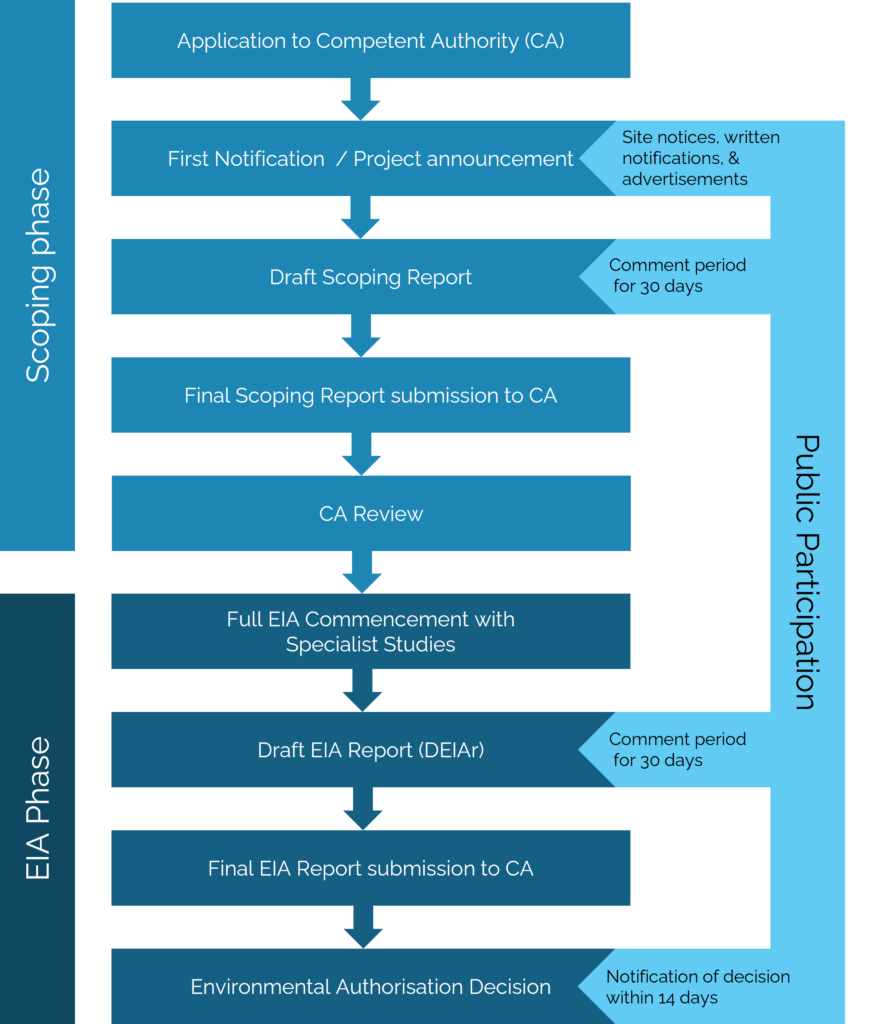
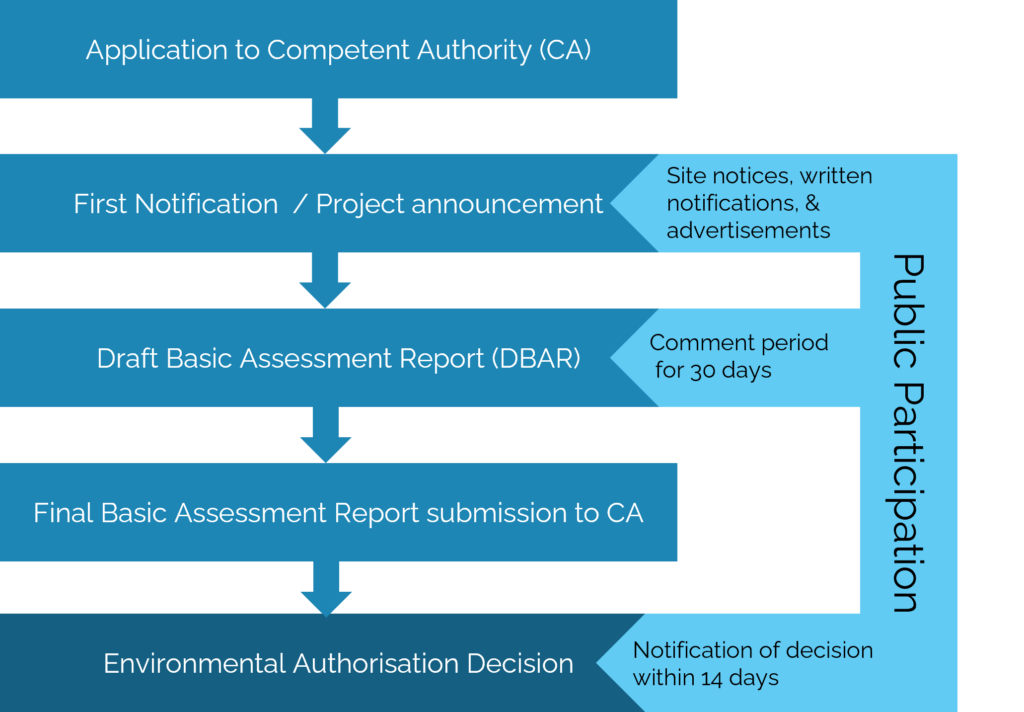
For both the EIA and BA process, public participation starts from the first notification received from the EAP. and continues until the end of the 30 commenting period for the Draft EIA Report or Draft Basic Assessment Report.Once the CA makes a decision, the EAP needs to notify all I&AP within 14 days.
Basic Assessment
Is a shorter process to submit an application for environmental authorisation. This is normally allocated for small scale activities and development with a low impact on the environment. The identified impacts are easily controlled.
Environmental Impact Assessment
This is a longer more comprehensive process that is set out to measure the full extent and environmental impacts through specialist environmental studies. The full EIA process is followed where significant environmental impacts have been identified and the nature of the activity is large and complex.
Publishing a draft EIA report, specialist studies and BID documents on an Environmental Services Company website is not the only component of PP.
Information needs to be made accessible and in a way that can be understood by anyone who wishes to participate by providing a comment. Therefore, the EAP needs to take into consideration language, level of education, disability and more.
As stated in our EIA regulations:
In order to give effect to the above guideline, PP must follow some minimum requirements, specifically:
The EAP or a person conducting a public participation process must give notice to all I&AP by:
Alternative methods for notifying I&AP need to be used, in those instances where a person is desirous of but unable to participate in the process due to illiteracy, disability or any other disadvantage.
Often sticking to the minimum requirement for PP is not enough for the public and I&AP to fully understand what a proposed development or activity is about, an importantly the contents of the EIA associated with it.
Unfortunately, we often see cases where the public strongly reject an application or EIA as they do not fully understand the EIA and specialist studies, or because information has not been made accessible in a digestible manner, or they feel as if not enough time has been made available to participate in the decision-making process.
To avoid this, EAPs need to strongly consider going beyond the standard requirements for conducting PP so that the process is inclusive, people can access information easily, registering a comment is easy, and I&AP can gain a good understanding of the proposed development or activity, and the Environmental Management Plan that will be put in place to mitigate potential impacts.
Public participation in the EIA process is comprehensive. We hope that this guide has provided you with some more clarity. Please note that this is a high-level overview. Depending on the nature of the activity, development and / or EIA, PP may require a much more in-depth process to alleviate any public concerns or conflicts that may be as a result of the proposed activity or development. For more information of PP, you are welcome to reach out to us at [insert email].